Do not Build a Mansion When All You Need Is a Hut: A "Maturity" Lesson from an IT Student

A personal story about ego, peer pressure, and a costly lesson in technology choices. Sometimes the simplest solution is not the easiest to accept, but it is often the right one.
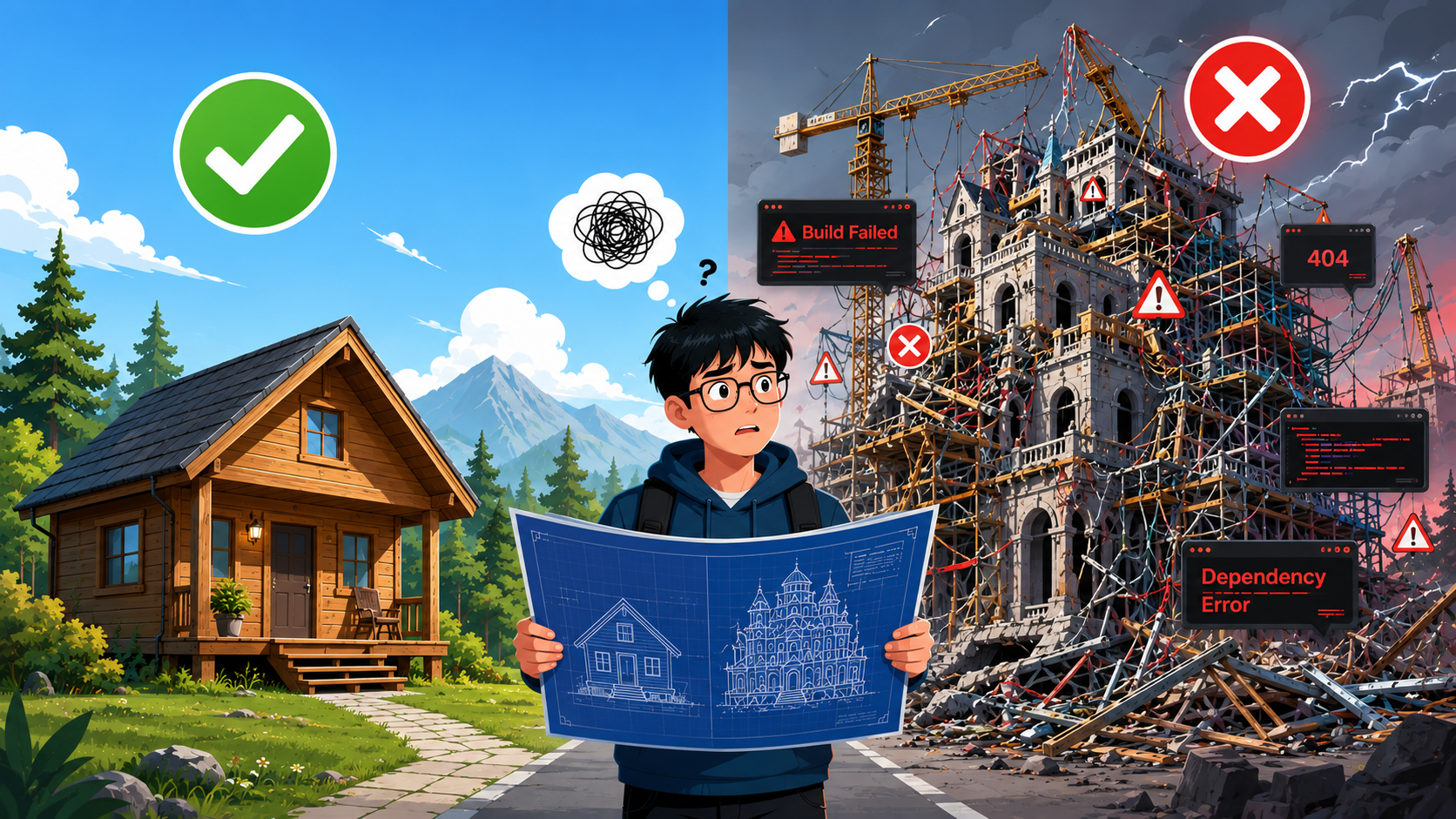
This is the story of a third-year college student who nearly sacrificed a friendship for the sake of his pride in front of a female classmate, the nights of panic — and the costly lesson about simplicity.
I Used to Think I Was "Cool"
Third year of university — the most precarious and stressful period of student life. Around me, friends were starting internships, boasting about offers from various companies. Peer pressure weighed heavily on my shoulders every day.
But honestly, the biggest motivation that drove me "crazy" during that year's major project came from a very... boyish reason: Our group had a girl.
In a male-dominated field like IT, having a female group member felt like a breath of fresh air. The instinct to show off, to prove myself as a solid "technical backbone," immediately surged. I wanted my CV to sparkle, and I wanted to shoulder a "massive" system architecture that would impress her.
Even though I had never taken a proper System Design course, relying only on a few concepts I'd gathered online, I boldly declared in our first group meeting:
"For this course, our group has to do Microservices. We need to split services, run Docker, configure Message Queues to make it top-notch. Doing a Monolith all in one chunk is so old-fashioned; the professor will just think we're lazy!"
Under the half-believing, half-skeptical gazes of my three friends, I felt like an "architecture god." I stayed up all night drawing a system diagram tangled with arrows and convoluted connecting blocks.
I thought that was true sophistication. But it was the beginning of a dark chain of mistakes.
The 2 AM Nightmare and the Powerlessness of Ego
We tried to build a mansion when we didn't even have a solid brick in hand.
As the defense date drew closer, the system crumbled. Instead of coding business logic, the four of us locked ourselves in our dorm room, spending 80% of our time fixing "invisible" errors: Docker environment issues, data discrepancies between services, and the nightmare called Git Conflict.
The night before the second progress demo, the clock struck 2 AM.
The moment I hit git push, the terminal screen instantly lit up with a series of crimson red lines. The system completely crashed. The Auth service crashed, taking down all other services with it. The more I tried to fix it, the more tangled the code became.
My best friend, sitting opposite me, slammed his hand on the table, his eyes bloodshot, and yelled: "Please, I'm begging you! Why did you even suggest this Microservices nonsense? Now even the local web app won't run, what are we going to report tomorrow? Are we all going to fail the course?!"
The atmosphere was suffocating. But what shamed me most at that moment was the worried, helpless look from the girl in our group. They had entrusted their grades to me, yet my "vanity" was dragging the entire team into the abyss. My arrogance shattered. That night, no one slept.
Suggested Image: A young programmer sitting in front of a laptop at 2 AM, the screen casting a red glow from error messages. Around him are tangled cables and chaotic floating icons of Docker, Kafka.

The "U-turn" Facilitated by the Professor
The next morning, we brought a completely broken system to class, mentally prepared to receive a failing grade. But the turning point came from the very person I had wanted to impress the most.
Seeing the situation was utterly hopeless, the girl in our group proactively went to speak with the professor privately before class to ask for advice. Right there at the desk, she gently suggested:
"The professor said our group is just making things difficult for ourselves. He grades based on whether the system runs with correct logic, not on how many trendy technologies we cram in. He advised us to scrap all this Docker and Kafka stuff, consolidate everything back into a Monolith to meet the deadline. What do you guys think?"
Those words were like a gentle slap that awakened me from my delusion. It turned out that while I was trying to use complexity to "flex" on everyone, her clear-headedness and practicality were what saved the entire group.
I cast aside my vain ego and nodded: "Yes, let's follow the professor's advice. We'll redo it."
The Magic of Simplicity
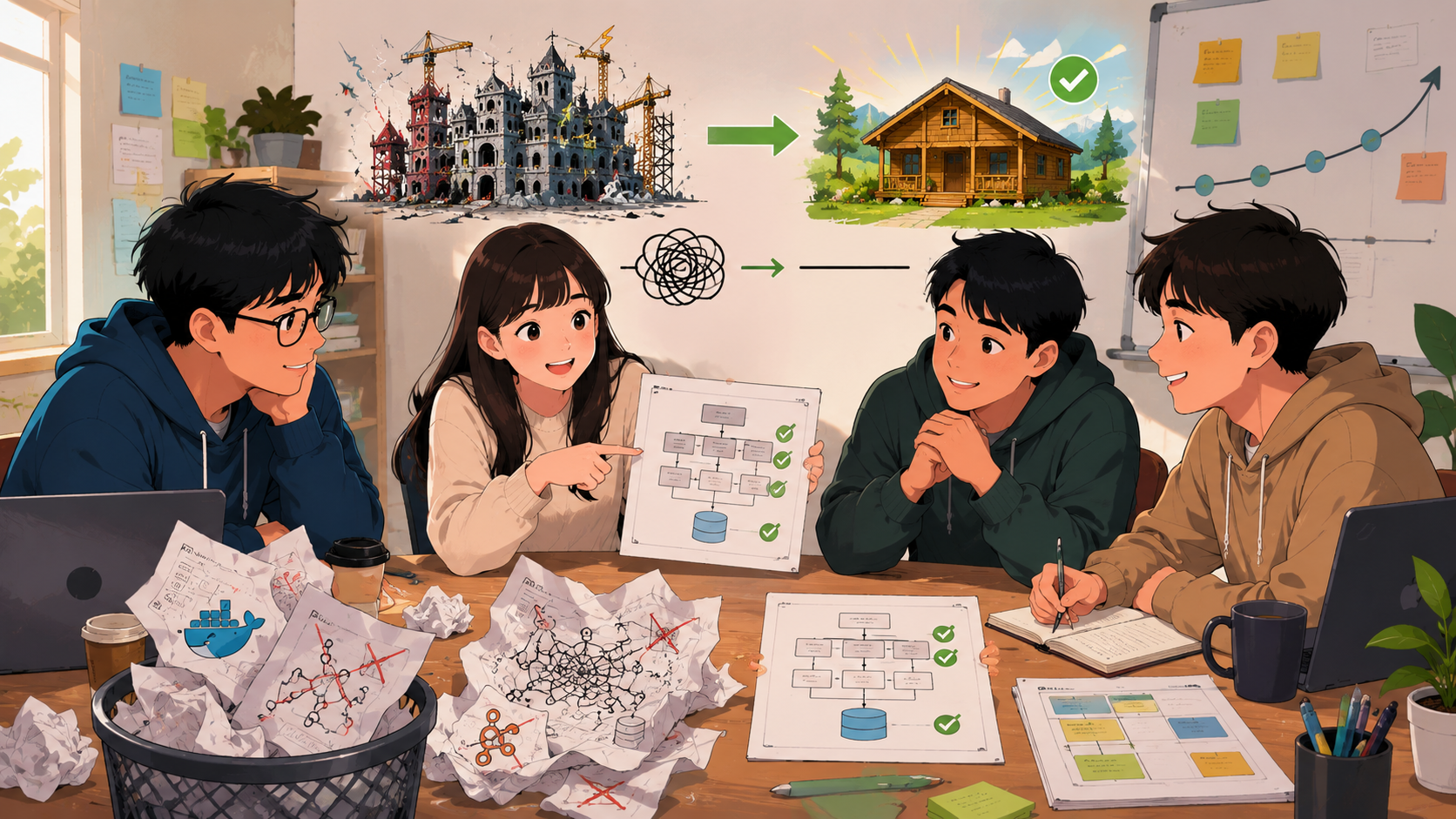
We threw all that tangled architecture into the trash and returned to a Monolith.
And a miracle happened. Once the superfluous complexity was discarded, the workflow accelerated incredibly. No more network errors. Finding bugs became incredibly easy.
Two days to get features flowing. Two days to optimize the interface and fix bugs. The girl meticulously handled the report slides. On presentation day, our group had a system that ran correctly, smoothly, and without a single flaw. The professor smiled and gave us an A.
Stepping out of the room, the four of us hugged each other tightly. It was the happiest A grade, but also a painful, hard-earned lesson bought with panic and nearly lost friendships.
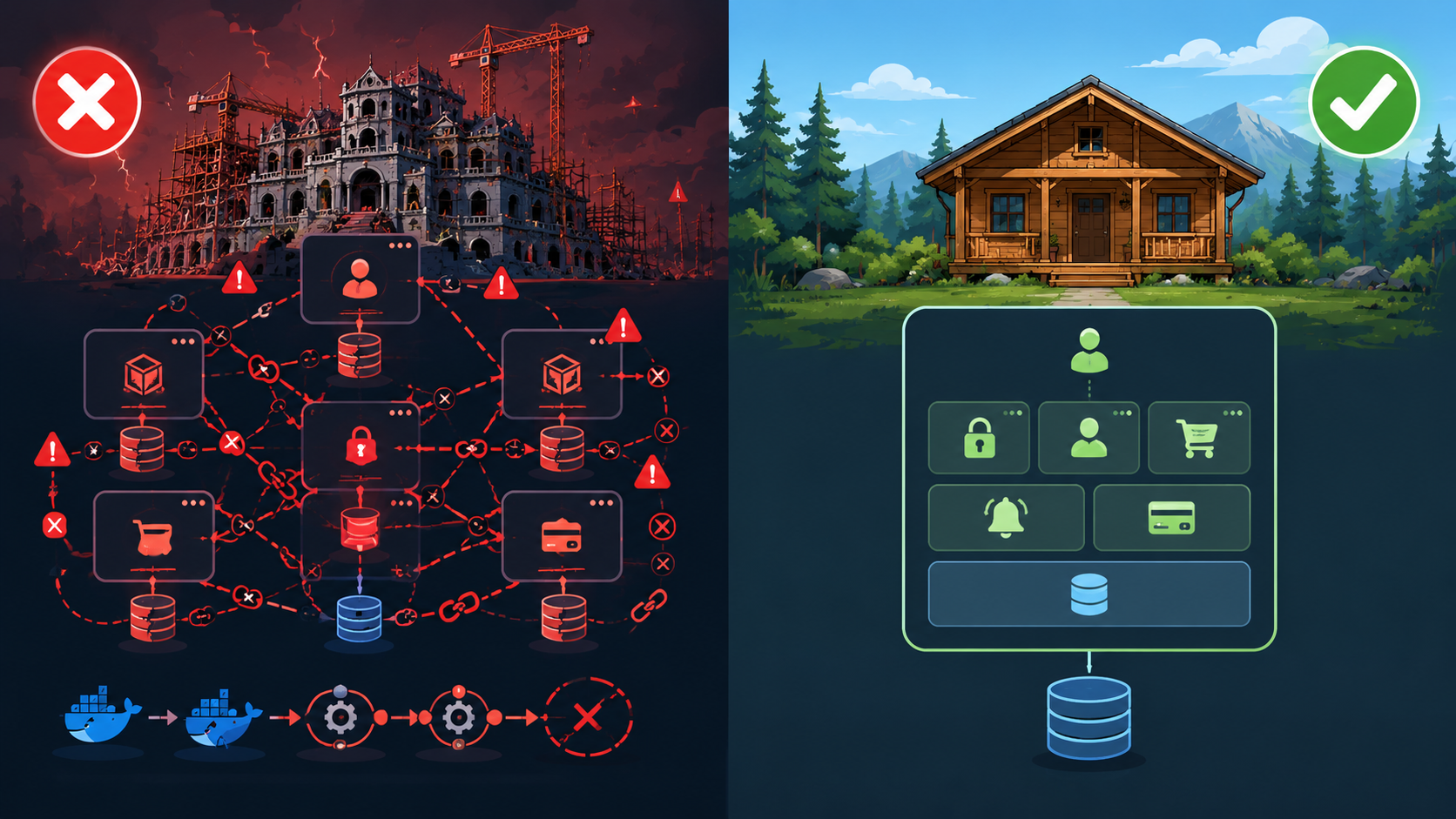
Suggested Image: Comparison Infographic - On the left is "MICROSERVICES" with a tangled mess of database icons and error warnings. On the right is "MONOLITH" with a neat, compact box integrating everything inside, along with a smooth green checkmark.
3 Things I Learned After the Storm
That third-year battle shaped my professional mindset forever:
- Technology is not a tool for vanity: Don't choose a technology just because it makes you look "cooler." Technology is born to solve problems in the most optimal way.
- Listening and simplicity always win: The pinnacle of programming isn't cramming a bunch of complex things together only to have them crash. Sometimes, the practical perspective of an outsider and the experience of those who came before you are the golden keys.
- Know where you stand: Don't force yourself to build a luxurious mansion when you don't even know how to build a sturdy tent to withstand a storm. A strong foundation allows for a tall house.

Conclusion
Now, whenever I receive a new backend task, the first question that always comes to mind is: "How can I keep it as simple and clean as possible while still perfectly solving the problem?"
The pinnacle of complexity, sometimes, is simplicity itself. And to truly mature in this profession, one sometimes has to learn to humble their ego first.