- 1. The shared problem of outsourcing: the “black box” of system development
- 2. The solution: making the whole process visible with “Chiho Client”
- 3. What exactly are you paying for?
- 4. How it compares with familiar models
- 5. The three major benefits transparency brings
- 6. How to get started
- 7. Conclusion: transparency is the first step to a successful project
- 8. References
Break the “Black Box” of Outsourcing with 100% Transparent Development — Experience ORT’s Task-Based Development

Jiro YamamotoBackend Developer
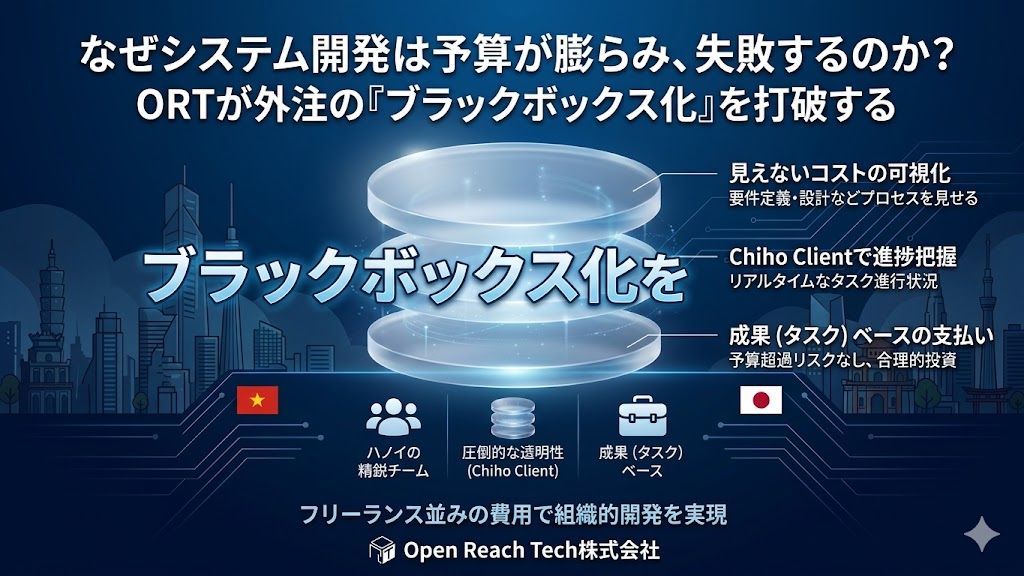
Have you ever felt uncertain when outsourcing software development because you could not clearly see where costs were being spent or what the current project status was? The “black box” nature of development progress is a common issue in outsourcing. This article explains how ORT solves that problem through its proprietary platform “Chiho Client” and its highly transparent Task-Based Development model — how work is broken down, how each delivery is reviewed, and how you know exactly what you are paying for.

Break the “Black Box” of Outsourcing with 100% Transparent Development — Experience ORT’s Task-Based Development
When outsourcing software development, have you ever felt anxious because:
- you could not tell where costs were being spent
- you did not know the real project status
- actual progress was hard to follow
Opacity during development is a problem shared by most companies that outsource.
In this article we explain how ORT solves it with our proprietary system Chiho Client and our Task-Based Development model, which keeps the work almost entirely visible.
1. The shared problem of outsourcing: the “black box” of system development
Under traditional outsourcing, clients rarely have a clear view of:
- which task is being worked on
- how long it is taking
- why progress has slowed
- the real state of the project
That lack of visibility does more than erode trust. It also causes:
- misunderstandings
- delayed decisions
- projects drifting off course
This is not a matter of individual ability.
It is a structural flaw of the traditional outsourcing model, where information turns into a black box by default.
2. The solution: making the whole process visible with “Chiho Client”
To solve this, ORT built its own system: Chiho Client.
It is not merely a communication tool.
Chiho Client is designed to:
- guarantee full transparency of development
- keep information in one place
- visualize every task and every log entry
That removes opaque process entirely and lets you see exactly where the project stands right now.
The model runs in three steps, and the three subsections below walk through them one by one.
Step 1: Break the work into clearly scoped tasks
Task-Based Development does not start with a thick contract. It starts by breaking a large feature into small, trackable tasks.
Take a request we receive constantly: “build the onboarding flow for new users.” It becomes:
| Task | Scope | Target date |
|---|---|---|
| 1. Signup form and validation | Signup screen, client and server validation, error messaging | Jul 28 |
| 2. Email verification flow | Verification mail, token handling, result screens | Jul 31 |
| 3. Profile setup wizard | Step-by-step profile input, draft saving | Aug 12 |
Every task carries three things:
- Scope: what is included, and explicitly what is not
- Estimated effort: expressed as the number of tasks it consumes
- Definition of done: agreed before the work starts, not after
This gives you two things a fixed-price contract cannot:
- You can reorder the remaining priorities without renegotiating the contract.
- When something slips, you see which task slipped and why, instead of hearing “the project is late.”
Step 2: Review each delivery as it is completed
In many outsourcing projects, the client only sees the product at the end of a sprint or a phase. By then, correcting a mismatch is expensive.
In Task-Based Development, every completed task is a delivery:
- The team publishes a preview of the finished work to Chiho Client, with its delivery timestamp.
- You look at it and leave feedback on the task itself — for example: “Can the song name be bigger?”
- The team applies the change and answers on the same task: “Updated - now 18px.”
- You either Approve to close the task, or Request changes to send it back to the queue.
Because the conversation lives next to the delivery, feedback stops scattering across chat threads, email and meetings.
What this changes in practice:
- Mismatched expectations surface while they are still small, instead of piling up until the end.
- Nothing is “basically done” — a task is closed only when you approve it.
- The review history is a shared record, not a matter of whose memory is better.
Step 3: Track progress in real time
Every movement in the project is recorded and can be inspected at any time.
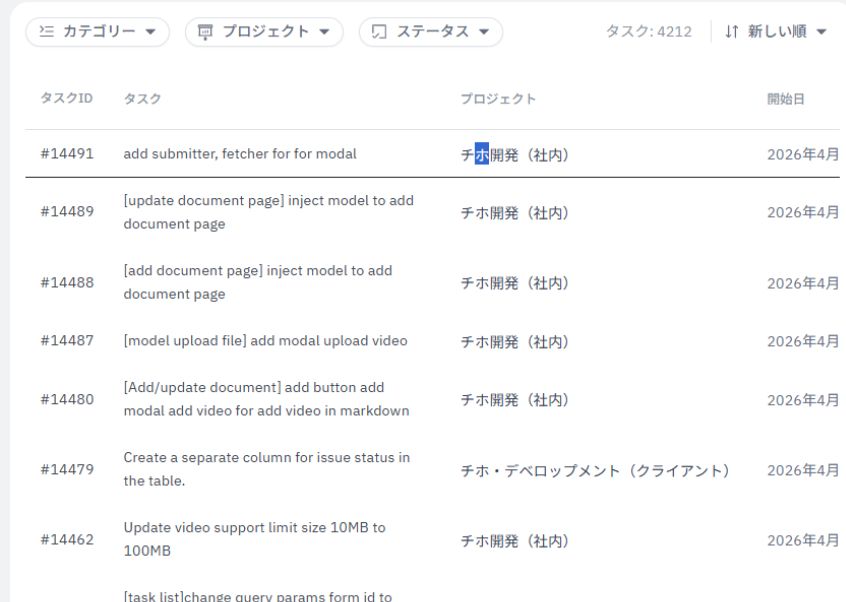
Real-time issue tracking
You can follow, at any moment:
- new features
- bug fixes
- issues in progress
- development throughput
Task-level transparency
For every task we record:
- what was done
- who was responsible
- how long it took
- its current status
There is no room for:
- hidden work
- unexplained hours
- unrecorded tasks
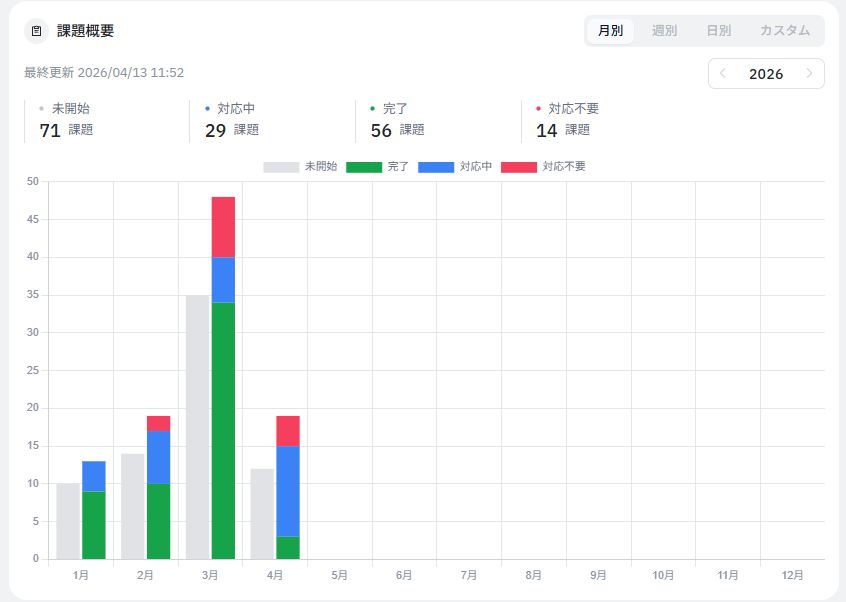
The overview dashboard
The dashboard answers the management questions at a glance:
- Tasks done: for example
14/22for the month - Days active: how long the project has been running since day one
- Status:
On Trackor at risk, with the time of the last update
An AI summary of the whole dashboard
Detailed numbers are useful, but decision makers usually have a few minutes. So Chiho Client can generate an AI summary of the entire dashboard: what moved in the period, which tasks are blocked, and what needs a decision from you.
You get the state of the project without reading every task yourself.
3. What exactly are you paying for?
This is the question the man-month model answers vaguely. Under Task-Based Development the answer is a number you can verify:
- The unit is a task, not “headcount × months.” Every task is estimated and its actual time is logged.
- A monthly quota: each month gives you a set number of tasks according to your plan.
- You own the priorities: within that quota, you decide what gets built first.
- Month-by-month adjustment: based on the consumption shown on the dashboard, you scale next month’s scope up or down.
- Fixing defects we introduced does not consume your quota. Bugs in work we already delivered are on us.
For pricing tiers and cost simulations, see New product development from ¥600,000 per month.
4. How it compares with familiar models
| Fixed-price | Man-month | Freelancer | Task-Based Development | |
|---|---|---|---|---|
| Scope is fixed | Entirely, up front | Monthly | Case by case | Per task |
| Changing requirements | Contract amendment | Possible, hard to measure | Depends on the person | Reorder tasks, no amendment |
| Progress visibility | At reporting milestones | Monthly report | Depends on the person | Real time, per task |
| Basis for billing | Package price | Headcount × time | Self-reported hours | Approved tasks |
| Start-up cost | High | Medium | Low | Low, start from an MVP |
| Dependence on individuals | Medium | Medium | High | Low — standardized process, transferable tasks |
5. The three major benefits transparency brings
Transparency is more than “knowing how the project is going.” It changes how the business operates.
1. Faster decisions
With a real-time dashboard and detailed logs:
- blind spots in the project all but disappear
- the current state is easy to grasp
- the next decision comes noticeably faster
2. Fewer misunderstandings and conflicts
When every task is recorded clearly:
- “I thought it would be…” happens less
- “we did / did not agree on this” arguments fade
- misalignment between client and development team shrinks
The relationship shifts from defensive to genuinely collaborative.
3. Stable, predictable collaboration
Because monthly task consumption is explicit, you can:
- adjust resources for the following month
- change priorities
- control the scope of development
The result is a stable, predictable development cycle.
6. How to get started
- First conversation: you share the product goal and your constraints. A complete requirements document is not needed.
- Breakdown and priorities: we turn the request into an estimated task list, and you confirm the order.
- Start and track in Chiho Client: you receive your account, watch progress, and review each task as it lands.
Frequently asked questions
Can we start without detailed requirements? Yes. We begin with a small set of tasks that clarify the requirements as we go, rather than asking you to freeze the whole scope on day one.
What if priorities change mid-task? Tasks that have not started can be reordered freely. A task already in progress is either finished or stopped by agreement, and the work already done stays visible on the dashboard.
Do we talk to the engineers directly? Yes. Communication happens on the task in Chiho Client, and our Hanoi team uses AI translation, so you can write in your own language.
How is maintenance after handover handled? Maintenance and improvements are tasks too, so they run through the same quota and review mechanism.
7. Conclusion: transparency is the first step to a successful project
Most failed development projects do not fail because of technology.
The real causes are usually:
- communication that drifts apart
- misread requirements
- no visibility into progress and cost
Small anxieties accumulate until they become problems that can no longer be fixed.
That is precisely why:
making the process transparent is the first step of every improvement.
ORT’s Task-Based Development and Chiho Client do more than display information.
They are built to resolve the communication problems at the root of outsourcing.
By making the entire process visible, we:
- remove the feeling of distrust
- reduce the anxiety of outsourcing
- get client and development team facing the same direction
That is the 100% transparent development model ORT is committed to.
8. References
To learn more about Task-Based Development, please review the material below or contact us through the form on this site.